
Onyfix or Surgery? How to Decide on Treatment for a Recurring Ingrown Toenail
Onyfix or Surgery? How to Decide on Treatment for a Recurring Ingrown Toenail
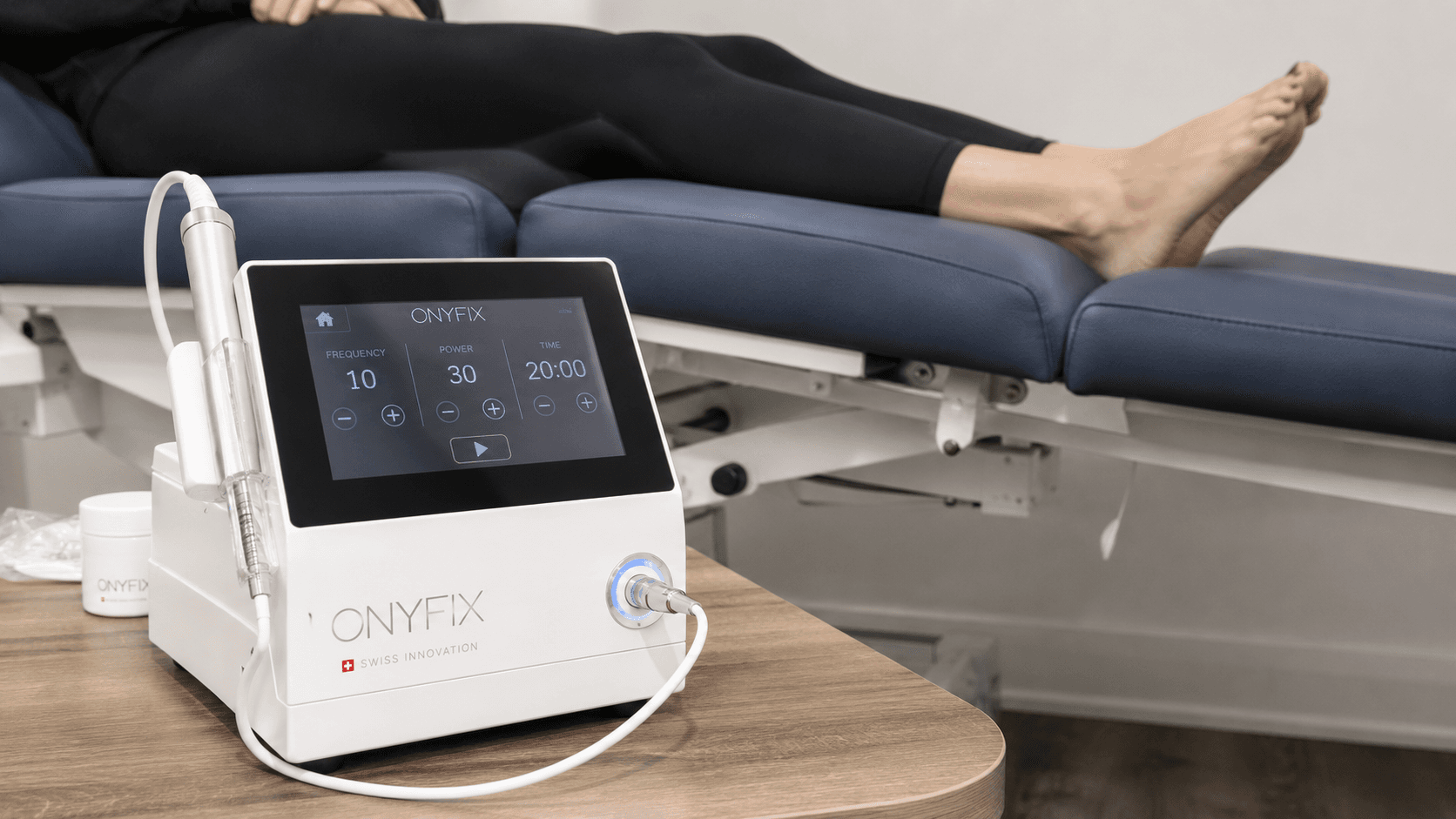
If the same toe keeps ingrowing, or you're facing a nail that's already causing real pain, a Chiropodist will usually lay out two established paths: Onyfix nail bracing, a non-surgical option, or a partial nail avulsion — a minor in-office procedure often referred to informally as "surgery." Neither is universally "better." Each fits a different situation. This guide walks through how a Chiropodist actually weighs the decision, so you know what to expect before your assessment at Donwood Foot and Orthotic Clinic in North York.
The Two Options at a Glance
Onyfix is a composite brace applied to the surface of the nail. It doesn't remove any nail tissue — instead, it uses gentle, progressive tension to reshape how the nail grows over several months. There's no anesthetic and no downtime.
Partial nail avulsion is a minor procedure performed under local anesthetic. A Chiropodist removes the narrow strip of nail that's digging into the skin and treats the underlying nail root (matrixectomy) so that specific edge stops regrowing. It's an in-office appointment, not a hospital procedure.
Both approaches are offered at Donwood as part of a conservative-first philosophy — see the full range of options on the ingrown toenails service page and the Onyfix nail correction page.
When Onyfix Tends to Be the Right Fit
The nail is curved or mildly-to-moderately ingrown, without significant infection or deep tissue involvement
You'd prefer to avoid a procedure, or a procedure isn't medically appropriate for you right now
The nail is trending toward ingrown but hasn't caused a severe episode yet
You're comfortable with a longer, gradual timeline (months, with periodic reapplication) rather than a single appointment
When Partial Nail Avulsion Tends to Be the Right Fit
The same corner has ingrown repeatedly despite conservative care
There's active infection, significant swelling, or the nail has already grown deep into the tissue
You want the specific problem edge addressed in one appointment rather than a multi-month process
Bracing has been tried and the same edge continues to cause problems
What a Chiropodist Actually Weighs During Assessment
The decision isn't a coin flip — it comes down to a short list of factors a Chiropodist checks during an in-person assessment:
Infection status — active infection or broken skin generally needs to be addressed before bracing is appropriate
Recurrence history — a first-time mild case and a fifth recurrence on the same corner are different conversations
Nail shape — a uniformly curved (involuted) nail responds differently than one with a single problem corner
Circulation and sensation — for patients with diabetes or reduced circulation, a Chiropodist factors in wound-healing considerations for either option; see diabetic foot care for more on this
Your own preference and schedule — some patients strongly prefer to avoid a procedure; others want the problem addressed in a single visit
Can You Try Onyfix First and Move to Surgery Later?
Often, yes. Because Onyfix doesn't remove any nail tissue, choosing it first doesn't close off the option of a partial nail avulsion later if the corrected shape doesn't hold or a specific edge continues to be a problem. Many Chiropodists apply a conservative-first sequence: try bracing where the presentation allows it, and reserve the procedure for nails that don't respond or that present too severely for bracing to be appropriate in the first place. Your Chiropodist can tell you at assessment which sequence makes sense for your nail.
Frequently Asked Questions
Is Onyfix or surgery better for an ingrown toenail?
Neither is universally better — they suit different presentations. Onyfix suits curved nails without significant infection where a patient prefers a non-surgical route. Partial nail avulsion suits a nail that's repeatedly or severely ingrown, or where infection is present. A Chiropodist's assessment determines which applies to your nail.
Does starting with Onyfix rule out surgery later?
No. Onyfix doesn't remove any nail tissue, so it doesn't close off a partial nail avulsion later if needed. Some Chiropodists use bracing as a first, conservative step before considering a procedure.
Is partial nail avulsion painful?
The procedure is performed under local anesthetic in the clinic; most patients describe pressure rather than pain during the procedure itself, with some soreness the first evening as the anesthetic wears off.
How do I know which option is right for my ingrown toenail?
An in-person assessment is the only reliable way to know. A Chiropodist examines the nail's shape, checks for infection, and asks about your history with the toe before recommending Onyfix, a partial nail avulsion, or continued conservative care.
Ready to Decide With a Chiropodist, Not a Search Engine?
An assessment takes the guesswork out of choosing between Onyfix and a partial nail avulsion. Donwood Foot and Orthotic Clinic is located at 51 Underhill Dr., Unit 4, North York — serving Don Mills, Leaside, Bayview Village, Willowdale, and the surrounding area.
Ready to stop guessing about your ingrown toenail? Book an assessment with a Chiropodist at Donwood Foot and Orthotic Clinic. 📞 (416) 445-1414 | Book an Appointment
Related reading: Ingrown Toenail: When to Treat It Yourself and When You Need a Chiropodist
If the same toe keeps ingrowing, or you're facing a nail that's already causing real pain, a Chiropodist will usually lay out two established paths: Onyfix nail bracing, a non-surgical option, or a partial nail avulsion — a minor in-office procedure often referred to informally as "surgery." Neither is universally "better." Each fits a different situation. This guide walks through how a Chiropodist actually weighs the decision, so you know what to expect before your assessment at Donwood Foot and Orthotic Clinic in North York.
The Two Options at a Glance
Onyfix is a composite brace applied to the surface of the nail. It doesn't remove any nail tissue — instead, it uses gentle, progressive tension to reshape how the nail grows over several months. There's no anesthetic and no downtime.
Partial nail avulsion is a minor procedure performed under local anesthetic. A Chiropodist removes the narrow strip of nail that's digging into the skin and treats the underlying nail root (matrixectomy) so that specific edge stops regrowing. It's an in-office appointment, not a hospital procedure.
Both approaches are offered at Donwood as part of a conservative-first philosophy — see the full range of options on the ingrown toenails service page and the Onyfix nail correction page.
When Onyfix Tends to Be the Right Fit
The nail is curved or mildly-to-moderately ingrown, without significant infection or deep tissue involvement
You'd prefer to avoid a procedure, or a procedure isn't medically appropriate for you right now
The nail is trending toward ingrown but hasn't caused a severe episode yet
You're comfortable with a longer, gradual timeline (months, with periodic reapplication) rather than a single appointment
When Partial Nail Avulsion Tends to Be the Right Fit
The same corner has ingrown repeatedly despite conservative care
There's active infection, significant swelling, or the nail has already grown deep into the tissue
You want the specific problem edge addressed in one appointment rather than a multi-month process
Bracing has been tried and the same edge continues to cause problems
What a Chiropodist Actually Weighs During Assessment
The decision isn't a coin flip — it comes down to a short list of factors a Chiropodist checks during an in-person assessment:
Infection status — active infection or broken skin generally needs to be addressed before bracing is appropriate
Recurrence history — a first-time mild case and a fifth recurrence on the same corner are different conversations
Nail shape — a uniformly curved (involuted) nail responds differently than one with a single problem corner
Circulation and sensation — for patients with diabetes or reduced circulation, a Chiropodist factors in wound-healing considerations for either option; see diabetic foot care for more on this
Your own preference and schedule — some patients strongly prefer to avoid a procedure; others want the problem addressed in a single visit
Can You Try Onyfix First and Move to Surgery Later?
Often, yes. Because Onyfix doesn't remove any nail tissue, choosing it first doesn't close off the option of a partial nail avulsion later if the corrected shape doesn't hold or a specific edge continues to be a problem. Many Chiropodists apply a conservative-first sequence: try bracing where the presentation allows it, and reserve the procedure for nails that don't respond or that present too severely for bracing to be appropriate in the first place. Your Chiropodist can tell you at assessment which sequence makes sense for your nail.
Frequently Asked Questions
Is Onyfix or surgery better for an ingrown toenail?
Neither is universally better — they suit different presentations. Onyfix suits curved nails without significant infection where a patient prefers a non-surgical route. Partial nail avulsion suits a nail that's repeatedly or severely ingrown, or where infection is present. A Chiropodist's assessment determines which applies to your nail.
Does starting with Onyfix rule out surgery later?
No. Onyfix doesn't remove any nail tissue, so it doesn't close off a partial nail avulsion later if needed. Some Chiropodists use bracing as a first, conservative step before considering a procedure.
Is partial nail avulsion painful?
The procedure is performed under local anesthetic in the clinic; most patients describe pressure rather than pain during the procedure itself, with some soreness the first evening as the anesthetic wears off.
How do I know which option is right for my ingrown toenail?
An in-person assessment is the only reliable way to know. A Chiropodist examines the nail's shape, checks for infection, and asks about your history with the toe before recommending Onyfix, a partial nail avulsion, or continued conservative care.
Ready to Decide With a Chiropodist, Not a Search Engine?
An assessment takes the guesswork out of choosing between Onyfix and a partial nail avulsion. Donwood Foot and Orthotic Clinic is located at 51 Underhill Dr., Unit 4, North York — serving Don Mills, Leaside, Bayview Village, Willowdale, and the surrounding area.
Ready to stop guessing about your ingrown toenail? Book an assessment with a Chiropodist at Donwood Foot and Orthotic Clinic. 📞 (416) 445-1414 | Book an Appointment
Related reading: Ingrown Toenail: When to Treat It Yourself and When You Need a Chiropodist
Chiropodist Foot Care Serving North York and East Toronto
Donwood Foot and Orthotic Clinic — 51 Underhill Dr., Unit 4, North York, ON M3A 2J8 · (416) 445-1414. Our Chiropodists provide foot assessments, custom orthotics, diabetic foot care, and medical foot care for patients from Don Mills, Parkwoods, Victoria Village, Leaside, Bayview Village, York Mills, Lawrence Park, Willowdale, Flemingdon Park, Henry Farm, Don Valley Village, East York, and across Toronto. Extended benefits accepted, with direct billing available for most major insurance providers. Book online any time at donwoodfootclinic.janeapp.com.
©2026 - Donwood Foot & Orthotics Clinic
Terms of Use
Created by
Clearmattr
©2026 - Donwood Foot & Orthotics Clinic
Terms of Use
Created by
Clearmattr
©2026 - Donwood Foot & Orthotics Clinic
Terms of Use
Created by
Clearmattr